
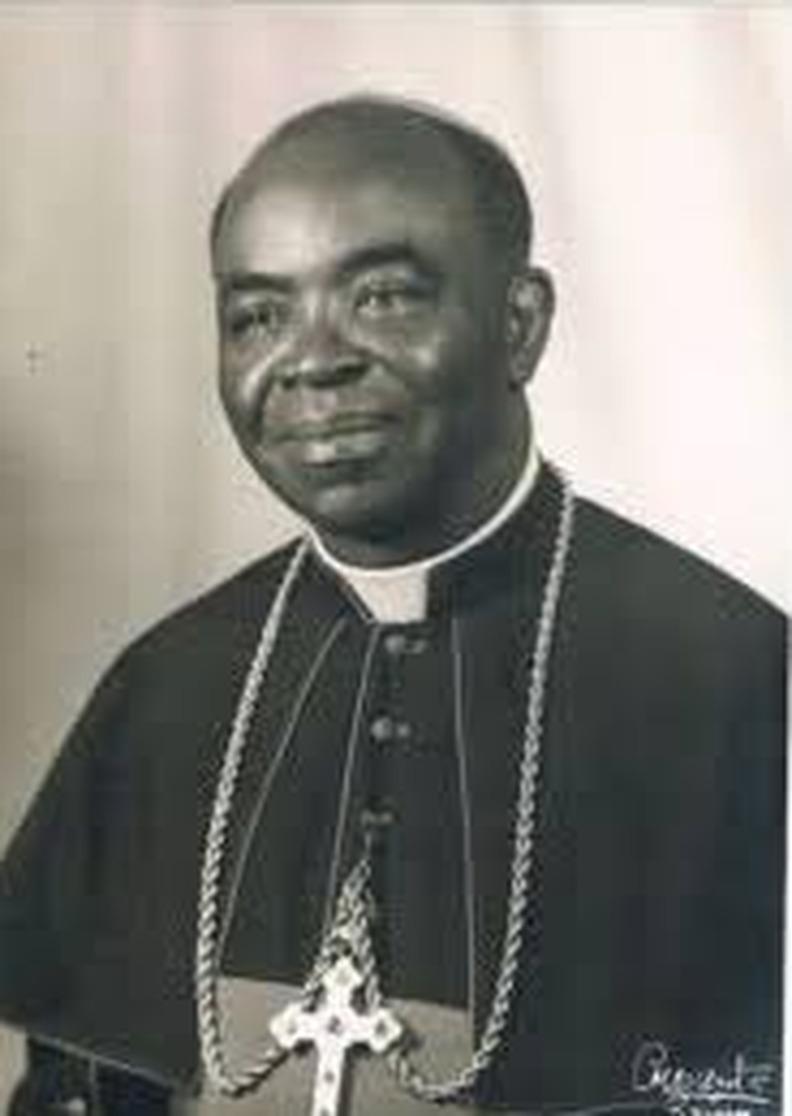

I first met John Kwao Amuzu Aggey in 1956. I was not quite sixteen years old and a Form Three student at St. Theresa’s Minor Seminary in Oke-Are, Ibadan. He had come to visit us, as many indigenous African priests did in those days, to offer words of encouragement as we discerned our aspirations for the Catholic priesthood.
Little did I know that barely a year later, in July 1957, John Kwao Amuzu Aggey would be chosen and ordained as the first indigenous Catholic Bishop of Lagos, serving as Auxiliary to the incumbent Archbishop of Lagos, Leo Hale Taylor, SMA; an Irish missionary prelate.
Following his episcopal ordination, Bishop Aggey was entrusted with the care of seminarians by Archbishop Taylor in his official capacity as Archdiocesan Vocation Director. In this role, he oversaw the recruitment and admission process for new candidates, while ensuring the pastoral and material welfare of those already studying at institutions like St. Theresa’s Minor Seminary, Oke-Are, and SS. Peter and Paul Major Seminary, Bodija Campus, Ibadan. Naturally, he looked after all seminarians sponsored by the Archdiocese of Lagos.
Though seminarians from other dioceses, such as Benin, Ondo, Ibadan, and Warri, were cared for by their respective vocation directors, Bishop Aggey, in his twin capacity as Vocation Director and Auxiliary Bishop, frequently visited us all.
My cherished memory of Bishop Aggey, or “Pa Amuzu” as we reverently called him in our private circle, was that of a loving patriarch. He truly delighted in being with his spiritual children, offering tender care, wisdom, and gentle guidance on what it truly takes to be a holy and dedicated priest.
His counsel was grounded in the rich fabric of his own life experiences, first as a mature seminarian and later as a priest serving in the Archdiocese of Lagos. Having worked as a gainfully employed civil servant for many years before heeding the call to the priesthood, Pa Amuzu possessed a vast reservoir of life stories. He shared these with us generously, weaving in captivating anecdotes and a warm sense of humour.
Moreover, his honest reflections on the challenges and temptations that once threatened to derail his own vocation became profound food for thought for us as young men. We could only marvel at his remarkable wisdom, his eloquence, and his effortless mastery of language. His command of African proverbs was legendary; the finesse with which he wove real-life experiences into any subject was nothing short of brilliant mark of a true oratorical genius.
Indeed, Aggey was an orator in the classic mold of the great figures of antiquity. Time and again, at Holy Cross Cathedral in Lagos and on various public platforms, he delivered homilies to packed congregations who sat spellbound, wishing his words would never end. Under his ministry, Holy Cross Cathedral was routinely filled to capacity for Sunday Masses, solemnities, and grand archdiocesan celebrations.
It was no surprise that many of us, while home on holiday, made pilgrimages to Holy Cross Cathedral just to listen to Bishop Aggey preach. Unconsciously, many young seminarians, myself included, began to absorb and model our own preaching styles after his.
A shining example of a disciple from this “Aggey School of Oratory” is the Most Reverend Dr. Felix Adeosin Alaba Job, Archbishop Emeritus of Ibadan. As a young boy growing up in Esure, Ijebu-Mushin, Ogun State, young Alaba Job lived in close proximity to Father Aggey, who served for many years as Parish Priest of Most Pure Heart of Mary Catholic Church. Serving as an altar boy under Father Aggey’s direct tutelage, he assimilated the prelate’s homiletic mastery firsthand.
Even today in retirement, Archbishop Alaba Job remains in high demand across the nation to preach at major religious celebrations. Whenever I hear him speak, I am convinced I am witnessing a true continuation of Aggey’s homiletic legacy. Though Archbishop Job and I were classmates from minor through major seminary (1955–1966), Job was particularly adept at capturing our mentor’s essence, having lived alongside him. Indeed, much of Archbishop Job’s lifestyle, his profound wisdom, welcoming smile, serene demeanor, and boundless kindness, remains a vibrant reflection of good old Pa Amuzu.
Archbishop John Kwao Amuzu Aggey (ordained priest in 1944) belonged to that heroic first generation of indigenous Catholic priests in Nigeria, alongside distinguished trailblazers like Monsignors Stephen Adewuyi, Julius Oni, and Lawrence Layode (all ordained in 1929). They were followed by Monsignors Joseph Sadiku (1937/1938), Pedro Martins (1943), Anthony Saliu Sanusi (1944, later Bishop Emeritus of Ijebu-Ode), Joseph Adeneye (1946), Michael Sanusi (1949), as well as Joseph Adeniyi and Patrick Somide (both ordained in 1954).
These pioneering indigenous priests, working alongside Archbishop Aggey, exerted a profound influence on us young men. Through their exemplary lives and fruitful pastoral ministries, they shattered the notion that the priesthood was meant only for foreign missionaries. They proved that a black African could serve with equal dignity and holiness. Inspired by their witness, we found the courage to approach our European parish priests and offer ourselves for seminary formation.
Archbishop Aggey was, above all, a deeply holy priest and an accomplished shepherd. He was a true man of the people who was approachable, grounded, and always ready to listen with compassion. He possessed the rare gift of stepping down to the level of the ordinary person, speaking in terms everyone could understand and identifying closely with their simple realities.
No event was too minor for him if his presence could bring joy. In December 1966, the month of my own priestly ordination, he graciously attended two separate receptions held in my honour. One was hosted by my family, and the other by my home parish, St. Paul’s in Ebute-Metta, Lagos.
During the reception at St. Paul’s, when I was called upon to respond to the toasts in my honour, I offered heartfelt gratitude to those who had guided me spiritually, academically, and financially; chief among them was Archbishop Aggey himself. I then paid tribute to my late father, Mr. Thomas Kudienyin Boyo, who had passed away six years earlier.
Two personal memories of his humility remain deeply engraved in my memory:
On the day of his episcopal ordination in July 1957, as he was elevated to Auxiliary Bishop of Lagos, Bishop Aggey remarked with genuine, heartfelt humility to a few of us who went to congratulate him: “For all these years, I politely declined opportunities to go to Rome for higher studies, hoping I would be spared the heavy burden of the episcopacy. Yet here I am! What I prayed to avoid has now come to pass. What do I do now?”
Another instance etched in my memory occurred years later following an archdiocesan gathering. Lacking a car of my own, I stood waiting by the roadside as several fellow priests drove past without stopping. Suddenly, Archbishop Aggey’s car pulled up. He personally stopped to offer me a ride to my destination. To see the Archbishop of Lagos willingly make room in his car for a young, newly ordained priest was an unforgettable lesson in Christlike humility and servant leadership.
Final Reminiscences
In early 1969, after completing nearly three years as a fidei donum priest on loan to the then Diocese of Ibadan, I returned to Lagos to serve as Assistant Parish Priest to Very Rev. Fr. John Kilbey at St. Michael’s Catholic Church, Lafiaji. Shortly after my arrival, Archbishop Aggey summoned me to the Chancery and generously offered to sponsor my postgraduate studies abroad. He gave me two choices: study Canon Law or Sacred Theology in Rome, or pursue higher degrees in the United States. I chose the latter, and late in 1969, I departed for the Catholic University of America in Washington, D.C., to study Social Anthropology.
Two years into my studies, in early March 1972, tragic news reached me across the ocean: my dear spiritual father, mentor, role model, and benefactor, Archbishop John Kwao Amuzu Aggey, had passed away. It was one of the saddest days of my life.
Archbishop Aggey served as a bishop for fifteen years; eight of those years as Auxiliary Bishop and seven as the substantive Metropolitan Archbishop of Lagos. Though his time as Archbishop was relatively brief, his impact was timeless.
May his gentle, noble soul rest in perfect peace. Amen.
Lux aeterna luceat eis, Domine, cum sanctis tuis in aeternum, quia pius es. Requiem aeternam dona ei, Domine, et lux perpetua luceat ei, cum sanctis tuis in aeternum, quia pius es.
(May eternal light shine upon him, O Lord, with Your Saints forever, for You are merciful. Grant him eternal rest, O Lord, and let perpetual light shine upon him with Your Saints forever, for You are merciful.)
Msgr. Christopher Adebowale Edema Boyo is a retired priest of Lagos Archdiocese. He was ordained on 18 December, 1966 by Archbishop John Kwao Aggey. This story is extracted from his book My Story My Song (2017) and repackaged in series by Fr. Michael Nsikak Umoh for our edification.
Comments
No comments yet. Be the first to respond.