
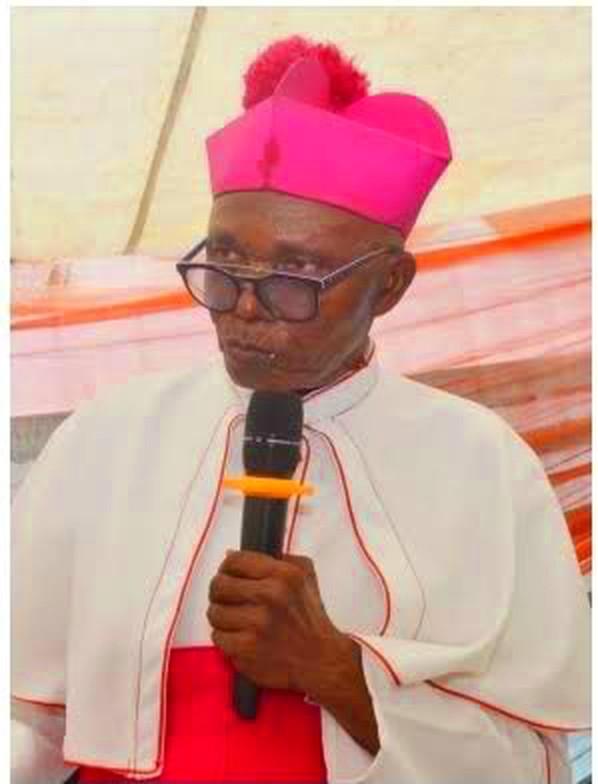

Homily for the 33rd Sunday in Ordinary Time (Year A)
Fr. Stan-William Ede, SSD
Seminary of All Saints, Uhiele, 15 November 2026
In honour of Very Rev. Msgr. (Prof.) Francis Ishola Ogunmodede (1948–2026)
“Εὖ, δοῦλε ἀγαθὲ καὶ πιστέ”, “Well done, good and faithful servant” (Mt 25:21). My dear friends, these words from today’s Gospel give us a clear measure of the Christian life. The three readings place definite expectations before us all, priests, deacons and seminarians preparing for the priesthood, as well as lay faithful alike. They speak of fidelity, a life awake to God, responsible work, and hands open to the needy.
They also give me a reason to speak today about Very Rev. Msgr. Prof. Francis Ishola Ogunmodede (Baba), our founding Rector, who departed this earthly realm on 30 October 2026. Although he is one among the many who will be remembered at tomorrow’s memorial Mass, I feel a deep personal obligation to speak about him, because his memory deserves a very special place in this Seminary and because I was among those he formed, and I know that if Baba had not accepted the task entrusted to him, we would not be sitting in this Seminary of All Saints as we know it today. Only very few persons here will be able to travel for his funeral; thus, it is pertinent for those of us gathered here today to know more of what he did for this Seminary.
Good and Faithful
Observe the Master’s two descriptions in the Gospel reading: ἀγαθὲ (agathe), meaning ‘good’, and πιστέ (piste), meaning ‘faithful’. ἀγαθὲ speaks to the servant’s moral character; πιστέ describes one who proves trustworthy in carrying out a responsibility. The praise concerns the kind of person the servant has become through his work. The Master says exactly the same words to the servant entrusted with five talents and the one entrusted with two.
Here is a measure of Christian greatness worth remembering in an age fascinated by popularity, titles and influence. Fidelity has a value that public applause cannot calculate. We should reflect on today’s readings with that measure in mind, and then look at Baba’s life as one concrete example of what such fidelity can achieve.
There is a memorable line in William Shakespeare’s Julius Caesar. As Mark Antony, in Act III, Scene II, addresses the crowd after Caesar’s assassination, he says, “The good is oft interred with their bones.” Antony is speaking as a skilled political orator, and his speech has its own purposes. Nevertheless, the words raise an uncomfortable question: how easily do we bury a person’s good work when we bury the person? We would not want the achievements of our founding Rector to become a few polite sentences at a funeral. His work is a core part of the history of this institution, and the young men who benefit from it deserve to know that history.
From Forest to Seminary
In the late 1980s, the Bishops of the Old Lagos Province (now Lagos, Ibadan and Benin City Ecclesiastical Provinces) made the decision to establish a new Seminary, and the people of Uhiele provided the land, which was handed over to the ecclesiastical authorities on 9 August 1990. In 1994, the Church appointed Fr. Ogunmodede the first Rector of the New Major Seminary. What Baba received four years after the handing over of the land was a large expanse of forest and an enormous assignment. There were trees to fell, thick bush to clear, stumps to remove and a vast compound to prepare for habitation, for formation and prayer.
In 1995, 42 young men drawn from 11 Dioceses became the first set of students that began formation in the Seminary, with only 2 pioneering full-time staff: Baba himself as the Rector and Fr. Anselm Jimoh as the Bursar. Brother Roman Centre in Ekpoma was used as a temporary site while the permanent home here in Uhiele was being built. From the beginning, the work called for money, sound judgment, perseverance and the willingness to face a problem without pretending that it would disappear on its own.
In 1996, the second set joined them at Brother Roman Centre. In 1997 they moved with the third set to the permanent site at Uhiele. I arrived in 1998 as a member of the fourth set, when much of the ground was still bushy and the campus was taking shape. Apart from the classroom blocks that you still use today, the old refectory, the old admin block, the old pit latrine (called Agbor), and the construction site at the guest house, nothing else was here. We had to adapt to conditions that were far from comfortable. Yet the academic work went on. Baba saw that a seminary could begin in difficult circumstances and still expect its students to take their vocation seriously.
The Parable of the Talents
Now a look again at the Gospel of this day. In Matthew 25:14-30, a man going on a journey entrusts his wealth to three servants, giving five talents, two talents, and one talent according to their abilities. In that setting, a talent was a very large sum of money, representing a serious trust. The first two servants put what they received to work and returned with an increase. They are commended equally, although the amounts differ. Matthew tells this story within the teaching of Jesus about the time between his departure and his return. Waiting for the Lord means exercising responsibility in the present. The question is what we do with what has been placed in our hands.
The third servant buries the money and explains his inaction by saying he feared the master. The severity of the ending should make us attentive. Matthew is warning against a life that allows fear to paralyse responsibility; he is not offering a religious justification for the pursuit of profit at any cost. Shakespeare again offers another way of describing that failure. In Act I, Scene IV of Measure for Measure, Lucio urges Isabella to act, warning that “Our doubts are traitors” because fear may cost us the good we could have done. Baba could have regarded the forest, the lack of facilities and the shortage of money as sufficient reasons to give up. Instead, he began working with the meagre resources available.
In the 12 years he was Rector, he saw to the uprooting of wild trees and the clearing of the vast compound. He constructed its high perimeter walls to improve security, and built most of the physical structures that are in this compound till date. Those buildings did not appear through an occasional ceremonial visit. Baba sought money for them, followed construction, dealt with contractors and kept the academic programme running while work continued. The facilities he left behind made it possible for later rectors and benefactors to develop the Seminary further.
Baba’s stewardship also required something beyond construction. A Seminary needs competent teachers, reliable administration, a programme of formation, clear academic expectations and a community whose members learn to live responsibly together. He worked tirelessly to establish these foundations alongside the physical development. That is why it would be incomplete to speak only of his buildings. The habits of serious study, personal discipline and pastoral availability that he required also became part of what he handed on.
One of his greatest contributions was the quality of the formators he recruited. Baba wanted us to learn from strong minds, wherever they could be found. He brought in many great priests, lay scholars and dedicated academic collaborators, who helped to build the teaching and formative community. He invested in people because he knew that buildings alone could never educate a priest. He also sought gifted priests and scholars beyond the dioceses of Western Nigeria. He brought Fr. Pantaleon Iroegbu of Okigwe Diocese all the way from Leuven, Belgium. He brought Fr. Greg Nnamani of Nsukka Diocese from Germany. And he brought Fr. Reginald Nwamadi of the Claretian Congregation from Europe as well. These priests of other climes were invited to a young seminary with limited facilities, and they served here as full-time resident formators and lecturers.
The trees stood thick when he arrived that day;
He called for hands to clear a working way;
He sought the help that came from far away;
With patient planning, he prepared a place to stay.
We read our books beneath kerosene light;
We studied through the silence of the night;
He brought good teachers who sharpened our insight;
Through steadfast study, he set our purpose right.
Keep Awake and Be Sober
At this point the second reading speaks with particular force. St. Paul tells the Thessalonians, “γρηγορῶμεν καὶ νήφωμεν” (grēgorōmen kai nēphōmen), “Let us keep awake and be sober” (1 Thess 5:6). The verb γρηγορῶμεν, from γρηγορέω, calls us to remain awake, watchful and vigilant. The verb νήφωμεν, from νήφω, asks us to stay sober, clear-headed and self-controlled. Both express an ongoing exhortation to cultivate these qualities. Paul is discussing the uncertain day of the Lord, which he says will come like a thief in the night. He is forming a community capable of living responsibly without pretending to control the future.
A person can be knowledgeable and still lack good judgment. He may become so attentive to money, prestige and powerful friendships that he loses sensitivity to the ordinary people who need his service. This is one way in which our age of celebrity culture can intoxicate the personality. Psychologists describe the feeling about how others rank us as status anxiety. When our sense of value depends on external admiration or outward success, we speak of contingent self-worth. Paul directs us towards another kind of maturity. Two verses beyond today’s reading, in 1 Thessalonians 5:8, he associates sober Christian living with faith, love and hope. Such qualities shape the heart as surely as serious study forms the mind.
That kind of maturity, viz. mindful vigilance, is needed in Nigeria today. Insecurity has left communities anxious, while political rivalry and harsh public language often make neighbours suspicious of one another. Christians should not add to the fear through reckless accusations, cruel jokes or the circulation of unverified rumours. Priests especially must resist the temptation to become performers in public quarrels. The Gospel asks us to defend human dignity, comfort the distressed and speak truth responsibly. A sober Christian listens carefully, recognises suffering, and acts without surrendering his conscience to the noise of the crowd.
I remember the practical form that vigilance took in our pioneer years. Baba was often on the road seeking the money needed for feeding, for construction and for all the various Seminary needs. When he returned, he was still our Rector and teacher. He made time to guide us and to address the difficulties of Seminary life. Some nights his office remained busy long after the usual working day. He had to attend to everything this Seminary needed to grow in all measures.
“Why Are You Here?”
There is a scene in House of the Dragon, Season 1, Episode 8 that helps us understand the human cost of leadership. King Viserys, already gravely ill, gathers his divided family at dinner. He removes the mask that hides his disfigured face and asks them to see him as their father and relative, rather than only as their king. For a brief moment, old enemies offer one another words of kindness. Although the peace proves fragile and the family’s struggle for power continues, Viserys can see that a great house is endangered when those who inherit it care more about position and acclaim than their bonds with one another.
A seminary is also an inheritance shared by many people. Those who lead it must care about the quality of its relationships as well as its rules and buildings. We learned from Baba that firmness and fatherly concern could belong together. He corrected us, demanded results and insisted on discipline, yet he was approachable, friendly, caring and fatherly. The question he often asked us was: “Why are you here?” He asked it of every Seminarian with such seriousness that we learned to turn it inward: “Why am I here?”
It was a question about intention. Had we come to become holy and available priests, or were we preparing for a title, social comfort and the privileges attached to it? Were we acquiring knowledge that would help us understand and serve people, or simply collecting qualifications? Baba’s challenge joined the intellectual life to the moral life. He wanted us to pray deeply, study carefully, act honestly, and be generous with ourselves.
Hands Open to the Needy
The First Reading of today gives another way to assess the life we are remembering. Proverbs 31 praises an אֵשֶׁת־חַיִל (’eshet ḥayil), a woman of strength, competence and resourcefulness. The poem describes careful work, prudent decisions and provision for a household. It belongs to an alphabetic poem that gathers many aspects of wisdom into one portrait. Its moral centre is especially clear in the verse chosen for today’s Mass: “She opens her hand to the poor and reaches out her hands to the needy” (Prov 31:20). The poem ends by praising the woman who fears the Lord and whose deeds speak for her (31:30–31). Her strength is visible in the people who benefit from it.
We must not reduce that portrait to a narrow checklist for women. It honours the real work, intelligence and generosity of women, and the whole Christian community can learn from its account of wisdom put into action. The woman in Proverbs works with skill, manages resources, provides for others and notices the needy. These are virtues that every priest, seminarian, teacher and public servant should cultivate. The text challenges any account of Christian maturity that stops with beautiful words and leaves the hungry unattended.
Here is one memory that I hope this seminary will never lose. When there was difficulty providing food for the students, and when the Bishops were considering closing the new Seminary due to hardship, Baba sold his personal car to feed the students. He could have treated the school’s financial trouble as an administrative inconvenience. Instead, he sacrificed all he had to ensure the Seminary’s continuity. That personal sacrifice gives concrete meaning to the open hands praised in Proverbs. We knew he was seeking help from benefactors, yet he also gave something of his own. Whenever I remember that decision, I think of how much responsibility can demand of a father.
Baba expected the same seriousness in intellectual work. Baba challenged us to read ten books for each course. He wanted us to know several authors, compare arguments and develop the habit of careful judgment. He required serious term papers and urged us to aim much higher than the minimum pass mark, often speaking of seventy percent and above. His own scholarship in African philosophy, the history of ideas and the political thought of Chief Obafemi Awolowo made those demands credible. He believed a future priest should be capable of thinking clearly and speaking responsibly about the lives of people he is sent to serve.
His concern for us continued beyond graduation. I am personally grateful for his guidance during my priestly ministry and further studies in Rome. I have now returned to teach in the institution where I once sat as his student. I remember his high expectations, his personal advice and his capacity to make time for people even when many problems demanded his attention. To you all, formators and students, I speak about Baba here today because institutional memory should include the work and character of those who made our present opportunities possible.
Three Readings, One Life
There is a connection among the three readings that becomes clearer when we look at this history. Proverbs praises strength expressed through responsible work and generosity. Paul urges us to remain vigilant and sober when the future is uncertain. Matthew calls us to be trustworthy with what we receive. Baba’s contribution to the Seminary of All Saints included all three:
- he graciously accepted the founding assignment,
- he worked through difficult circumstances, and
- he cared for the material and spiritual needs of the Seminary community.
These are the qualities we ought to learn from him, while remembering that he, like every servant of God, depended on Divine grace and on the contributions of many others.
He planned and prayed far into the night;
He kept the lamp of learning bright;
He drew tomorrow’s hopes into the light;
With steadfastness, he shaped this sacred site.He gave his all that students might be fed;
He sought out help when funds had fled;
He listened to the troubles left unsaid;
With firm fatherly faith, he forged a path ahead.He watched our minds and confidence grow;
He asked us why we came, so we would know;
He taught the truths that we were called to sow;
Steering us onward, he showed us how to glow.
We owe gratitude as well to the bishops who established this Seminary, the people of Uhiele who gave the land, the benefactors who contributed, the priests and scholars who answered Baba’s invitation, the workers who built, and the successive rectors and staff who have developed the school since 2006. Recognising their contributions helps us understand the responsibility Baba accepted at the most difficult stage of the project. What remains before us is a functioning Seminary, a community of teachers and students, and generations of priests who have carried its formation into parishes and other fields of service.
My dear friends, as Baba’s funeral approaches, let us honour him through prayer and by taking his question seriously: “Why am I here?” Why am I in this seminary? Why have I been ordained? Why has God entrusted these people and these duties to me? The Master’s final praise will concern the fidelity of our answer.
We pray to God to grant eternal rest to the soul of Msgr. Francis Ishola Ogunmodede. May those of us who inherit the fruit of his sacrifices live in a way worthy of them. And when our own account is asked of us, may we hear the words with which we began: “Εὖ, δοῦλε ἀγαθὲ καὶ πιστέ.” “Well done, good and faithful servant.”
And may God fulfil His plan in our lives, through Christ our Lord. Amen.
Read also: He Built the Future: Tribute in Honour of the Late Msgr. Prof. Francis Ogunmodede · A Life of Service, a Legacy of Faith: A Tribute to Msgr. Prof. Francis Ogunmodede · Adieu, Baba! OSOBAN Set 1974/75–1979/80 Pays Tribute to Msgr. Prof. Francis Ishola Ogunmodede · Follow Msgr. Ogunmodede’s Funeral on Lumen Christi.
Comments
No comments yet. Be the first to respond.