
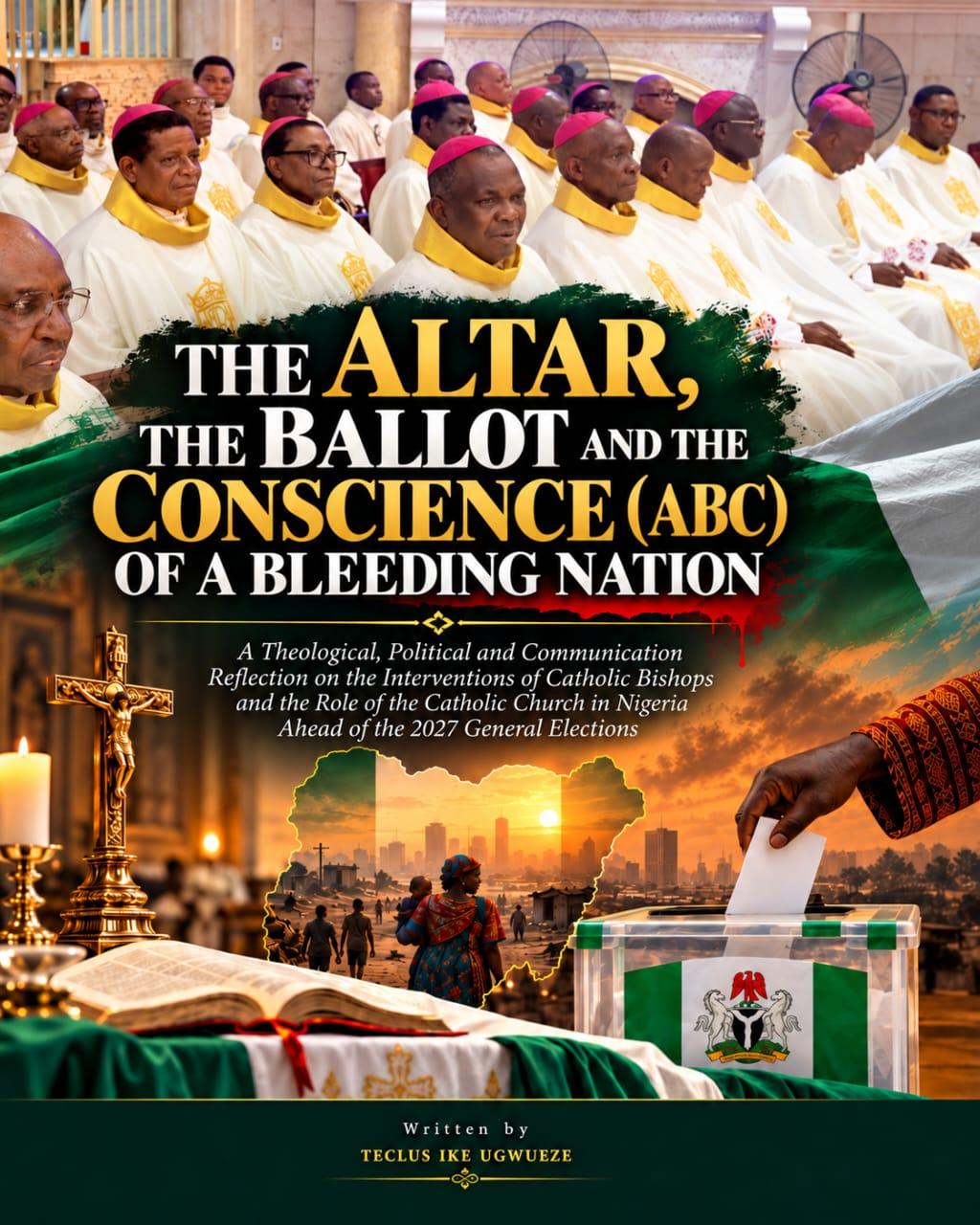

A Theological, Political and Communication Reflection on the Interventions of the Catholic Bishops and the Role of the Catholic Church in Nigeria Ahead of the 2027 General Elections
The Church must be politically relevant without becoming politically captive.
Introduction
Can the Church remain faithful to Christ if she becomes too comfortable with Caesar? Can she remain faithful to suffering humanity if she withdraws from the political realities that determine human existence? These questions expose a persistent tension in Christianity: the obligation to safeguard truths that do not change and the responsibility to respond to a world that does. They also bring into focus the freedom without which the Church cannot speak credibly to political power.
On Friday, 23 October 2026, at 5:00 p.m., the Faculty of Theology of the Pontifical University of the Holy Cross (Santa Croce) in Rome held an academic event in the John Paul II Aula Magna in honour of Professor Paul O’Callaghan and his long career in theological research. A Doctor of Theology from the University of Navarra, he taught there for five years and at Santa Croce for thirty-six years; he has authored twelve books, with particular interests in eschatology, theological anthropology and the theology of creation. Reflecting on that academic occasion, and on the questions raised in our studies of the Church’s doctrine on communication, led me back to O’Callaghan’s article, “Is the Christian Believer Conservative or Liberal?” It was not a Nigerian political address by the professor that occasioned this essay, but the opportunity to consider how his theological insight bears upon the concrete circumstances of my country.
O’Callaghan’s question challenges the reduction of Christian identity to competing ideological labels. A Christian is not simply a defender of everything inherited, nor an unquestioning supporter of everything presented as progress. The believer receives and safeguards truth in Christ while exercising freedom and responsibility within the changing conditions of history. The Christian must therefore distinguish what must never be surrendered from what must never be allowed to remain unchanged. If Christianity were merely conservative, the Church could be tempted to defend institutional privilege and comfortable relationships with political authority, even where justice calls for reform. If it were merely liberal in a superficial ideological sense, she could surrender lasting moral principles to every new political fashion. The Gospel permits neither captivity: the Church must be faithful enough to preserve the truth and courageous enough to challenge arrangements that contradict it.
This distinction becomes urgent when placed against the political and existential crises of contemporary Nigeria. Insecurity, displacement, corruption, economic hardship, unemployment and widespread disillusionment make politics a question of human survival, not merely of electoral preference. A religiously vibrant nation cannot afford a Christianity that decorates power with sacred language while ordinary people struggle to live with dignity. Neither can it afford a Church that retreats from public affairs, as though the suffering of citizens were unrelated to her proclamation of the Gospel. The question, then, is not whether the Church engages politics, for she already does whenever she defends human dignity, promotes justice and forms consciences; it is whether she can do so while remaining free from partisan ownership.
The Catholic Church in Nigeria has already given important evidence of this freedom. Through the Catholic Bishops’ Conference of Nigeria and the interventions of Cardinal John Onaiyekan, Archbishop Emeritus of Abuja, Bishop Godfrey Igwebuike Onah of Nsukka, Bishop Wilfred Chikpa Anagbe of Makurdi, Bishop Matthew Hassan Kukah of Sokoto and many others, the episcopate has reminded successive governments of their obligations to the people. Their criticism should not be mistaken for automatic opposition to a government; a shepherd who challenges injustice may be calling an administration to discharge the responsibility for which it was entrusted with power. Yet the public endorsement of politicians by some other religious bodies also raises a necessary question about the independence of religious witness. Such support is not automatically dishonest, but it must be scrutinised whenever the appearance of spiritual authority is used to validate political loyalty without adequate attention to the nation’s suffering.
This essay argues that the Catholic Church must remain a prophetic, credible and morally independent participant in Nigeria’s democratic life: politically relevant without becoming politically captive. It first affirms the collective and individual interventions of Nigerian Catholic bishops, then considers the moral and communicative dangers of religious endorsements. It next addresses the respective responsibilities of priests and the lay faithful, relates them to the Church’s social and communication teaching, and concludes by insisting that ecclesial concern for public accountability must continue well beyond the 2027 elections. Throughout, one question remains decisive: when political power approaches the altar, will it encounter the courageous but prudent voice of conscience, or merely the comforting echo of its own ambitions?
1. In a wounded Nigeria, the Catholic Church has not been silent
There are moments in the life of a nation when silence becomes more than the absence of words. It becomes a moral question. Nigeria is living through such a moment, from the displaced communities of Benue to the villages threatened by insecurity in different parts of the country. The magnitude of Nigeria’s insecurity becomes clearer when its different regional manifestations are considered. In the North-East, the prolonged insurgency associated with Boko Haram and the Islamic State West Africa Province (ISWAP) has devastated communities and displaced families. In the North-West, armed banditry, kidnappings for ransom and attacks on rural settlements continue to threaten lives and livelihoods. Across parts of the North-Central region, particularly Benue and Plateau States, recurrent attacks on farming communities, communal violence and forced displacement have aggravated humanitarian suffering, while the South-East continues to grapple with separatist-related violence, attacks by armed groups and the disruption of economic and social activities. These overlapping crises reveal that insecurity in Nigeria is not merely a question of territorial control or political stability; it is fundamentally a crisis of human dignity, social trust and the state’s responsibility to protect its citizens. It could also be lamented that amidst these security challenges, families are struggling with the rising cost of living, unemployed graduates are uncertain about their future, health facilities are in an agonising state, and communities are deprived of basic infrastructure. The suffering of ordinary Nigerians raises urgent questions about the responsibilities of political leadership. In such circumstances, the Church cannot remain indifferent.
Yet it is important, before examining the political responsibilities of the Church in Nigeria, to acknowledge a fundamental truth: the Catholic Church in Nigeria has repeatedly demonstrated that she understands her prophetic responsibility to the nation. Through the Catholic Bishops’ Conference of Nigeria, her pastoral letters, public communiqués, homilies, peace initiatives and interventions in national affairs, she has consistently reminded successive governments that political authority exists for the service of the people. This witness has not been confined to one administration or one political party. The Catholic bishops have spoken about corruption, religious freedom, insecurity, the sanctity of life, electoral credibility, economic hardship and the dignity of the poor. Their interventions demonstrate that the Church’s concern for justice is neither a new development nor an electoral strategy.
At their September 2026 plenary meeting in Osogbo, the bishops renewed this commitment. Under the leadership of Archbishop Matthew Man-Oso Ndagoso, they challenged the government over insecurity, poverty and failures in the protection of human dignity. They also called for free, fair and credible elections in 2027, urging citizens to exercise their political responsibilities conscientiously. Their message was not a campaign manifesto. It was a moral evaluation of the condition of the nation. And herein lies the difference between the authentic prophetic mission of the Church and the temptation to become captive to political power. The Church does not need to control the government to hold it morally accountable. Neither does she need to endorse the opposition to criticise those in power. Her authority comes from the Gospel, not from any political coalition.
2. Cardinal Onaiyekan: Truth must not become the casualty of access to power
Archbishop Emeritus of Abuja, Cardinal Onaiyekan has consistently emphasised accountability, truthfulness and the right of citizens to question those elected to govern them. Among the outstanding examples of this prophetic witness is his recent intervention, which demonstrates an important principle: dialogue with government must never be confused with surrender to government. Following the Catholic bishops’ meeting with President Bola Tinubu on 28 July 2026, Cardinal Onaiyekan publicly explained that the bishops had presented their concerns about the state of the nation, even though the President disagreed with their assessment. The significance of this encounter is not that the bishops gained access to the President. It is that they used that access to communicate concerns they believed needed to be heard. In August 2026, Cardinal Onaiyekan further called upon Nigerians to demand accountability from public officeholders rather than regard themselves as powerless subjects.
This is a crucial lesson for religious leadership. The Church must not become so delighted by an invitation to the Presidential Villa that she forgets the suffering of the people outside its gates. Indications therefore emerge that an audience with the President is an opportunity for pastoral and moral engagement. It is not a reward that requires ecclesiastical silence. The Cardinal’s witness reminds us that the purpose of religious access to political power is not to obtain prestige, but to communicate truth, represent legitimate human concerns and encourage accountability. A Church leader who enjoys access to government but cannot speak critically when justice demands it has gained proximity at the expense of freedom.
3. Bishop Godfrey Onah: When the shepherd refuses to flatter power
Another significant example is Bishop Godfrey Igwebuike Onah of the Catholic Diocese of Nsukka. Over the years, Bishop Onah has confronted issues of poor governance, political irresponsibility, social division and the consequences of injustice. In a widely reported homily in July 2021, he criticised governance failures that had contributed to the celebration of questionable public figures and the erosion of moral standards. His concerns have extended across different political administrations. In February 2026, a published commentary examined his warnings concerning the deterioration of Nigeria’s democratic culture and the responsibility of political leaders.
The significance of this witness extends beyond the language of any individual homily. It reminds us that the Church cannot preach honesty to ordinary citizens while remaining indifferent when public authority rewards dishonesty. It cannot encourage young people to respect the law while ignoring situations in which political influence appears to place powerful persons above accountability. It cannot preach the dignity of work while treating youth unemployment, preventable deprivation and widespread frustration as matters unrelated to Christian responsibility. Bishop Onah’s interventions also reveal something essential about prophetic communication: its credibility depends on consistency. A bishop who criticises injustice under one government must retain the freedom to criticise injustice under another. This consistency is not hostility to political authority. It is fidelity to a moral standard that transcends political authority.
For priests and the faithful, the lesson is equally important. When a bishop speaks about the dignity of human life, the evils of corruption or the obligation to protect citizens, those teachings deserve serious attention. They should not be dismissed merely because they make a preferred politician uncomfortable. The moral authority of the Church cannot be accepted only when its teaching favours our political sympathies.
4. Bishop Wilfred Anagbe: When the voice of the displaced becomes the voice of the shepherd
The advocacy of the Catholic Bishop of Makurdi, Bishop Wilfred Chikpa Anagbe, has brought the suffering of displaced communities in Benue State before national and international audiences. The witness of Bishop Wilfred Chikpa Anagbe of Makurdi presents a particularly moving example of the social responsibility of episcopal communication. For years, communities within his diocese have experienced serious violence, displacement and the destruction of homes, farms and places of worship. Bishop Anagbe has spoken publicly about these experiences, bringing the plight of affected communities to audiences beyond Nigeria. In November 2025, he submitted testimony to a United States congressional committee concerning attacks and displacement in Nigeria. In June 2026, he again called for justice and the safe return of displaced families following the anniversary of the Yelewata massacre.
The importance of such interventions is not merely that a bishop has criticised the government. It is that he has refused to allow the suffering of his people to disappear into silence. When a community loses its ancestral home, political debates about insecurity become painfully concrete. When farmers are unable to return to their land, the consequences extend beyond physical danger to the destruction of livelihoods, food security, education and cultural identity. When churches, homes and schools are destroyed, the task of pastoral leadership necessarily includes defending the people whose lives have been disrupted.
Bishop Anagbe’s advocacy reminds us that the shepherd cannot be indifferent to the wounds of the flock. It is therefore deeply troubling when accounts of widespread suffering are met primarily with efforts to protect the reputation of political authorities rather than a serious examination of the conditions endured by affected communities. The Church must be fair in assessing claims and careful with facts. But fairness does not mean indifference, and national unity cannot be built by asking victims to remain silent. A Church that speaks for the displaced is not interfering in politics. It is defending the human dignity that politics exists to protect.
5. Bishop Kukah and the wider witness of the Nigerian episcopate
This prophetic responsibility is not limited to the bishops already mentioned. Bishop Matthew Hassan Kukah has remained a prominent voice in Nigeria’s moral and democratic discourse, advocating justice, accountable governance, religious coexistence and national reconciliation. His thought-provoking Christmas messages, particularly those of 2020, 2024 and 2025, have consistently challenged successive political administrations over insecurity, corruption, economic hardship and failures of leadership, while encouraging citizens to embrace their own moral responsibilities. His interventions demonstrate that the Church’s prophetic mission transcends political affiliations, demanding both the courage to confront injustice and the fairness to acknowledge genuine achievements in governance. Through this sustained witness, Bishop Kukah has contributed significantly to the formation of public conscience and the pursuit of a more just, peaceful and united Nigeria. In September 2026, he joined Cardinal Onaiyekan in encouraging Nigerians to participate responsibly in the forthcoming elections, with emphasis on the value of human life and peaceful democratic participation.
Many other Nigerian Catholic bishops, including those whose dioceses have directly experienced violence and humanitarian hardship, have contributed to this collective witness through pastoral teaching, humanitarian action and public engagement. We should also remember that the most meaningful work of the Church is not always captured by national headlines. It is visible in diocesan Justice, Development and Peace Commissions, in the care offered to displaced persons, in Catholic hospitals and schools, in peacebuilding initiatives and in the daily pastoral service of priests and religious. The public interventions of the bishops are strengthened by these concrete expressions of solidarity. What emerges from this collective witness is a coherent ecclesial principle: the Church’s political mission is not to secure victory for a candidate, but to defend the conditions in which human beings can live with dignity, freedom, security and hope.
6. When religious endorsement becomes political merchandise
Against this background, the recent endorsement of President Bola Tinubu by a group identifying itself as the Charismatic Bishops Conference of Nigeria deserves careful reflection. At its September 2026 gathering in Abuja, the group’s president-general, Archbishop Leonard Bature Kawas, announced support for the President’s re-election in 2027. The declaration was publicly reported, including by the Federal Ministry of Information and National Orientation. It is important to emphasise that this body is not the Catholic Bishops’ Conference of Nigeria, notwithstanding the shared abbreviation CBCN. Nor would it be fair, without sufficient evidence, to dismiss every member of that organisation as a fraudulent religious leader or to assume that their endorsement was financially motivated.
Nevertheless, their action raises a serious theological and communication question. What happens when religious authority is publicly committed to the electoral success of a particular politician? The problem is not that a Christian leader must oppose every government. A government deserves recognition for genuine achievements. Political reforms should be assessed fairly, and no administration should be condemned merely because its leaders belong to an opposing political tradition. The problem arises when religious leaders appear to offer political loyalty without sufficiently confronting the suffering of the people. Consider the painful contrast.
In one part of Nigeria, a displaced family is asking whether it will ever return home. In another, a mother is struggling with the cost of feeding her children. Elsewhere, young Nigerians are searching for employment and questioning whether their country offers them a future. At the same time, religious personalities may gather before television cameras to celebrate the political achievements of those exercising power. The question is not whether the government has achieved anything worthwhile. The question is whether religious praise remains proportionate, truthful and attentive to the full condition of the nation. There is something morally unsettling about unqualified political celebration when profound human suffering remains insufficiently addressed.
The biblical prophets did not measure the success of kings by their proximity to religious institutions. They examined whether rulers defended justice, protected the vulnerable and governed responsibly. The same standard must apply in Nigeria. Religious leaders must be particularly careful when their public endorsements are used to imply that divine favour rests upon a political candidate.
A blessing is not an electoral certificate. A prayer is not a campaign advertisement. A religious title does not confer political infallibility. And a gathering of bishops does not automatically represent the judgment of the Catholic Church. Our study of audiovisual language makes this concern even more urgent. Once images of religious leaders standing beside politicians are circulated, their meaning is influenced by captions, camera angles, timing, political slogans and the intentions of those distributing them. An apparently religious image can become a powerful instrument of electoral persuasion. The Church must therefore guard the distinction between pastoral engagement and partisan identification. The altar must remain a place where politicians encounter moral responsibility, not a stage on which political power receives automatic religious approval.
7. A particular appeal to Catholic priests: Stand with your bishops in the defence of moral principles
The courage of the Catholic bishops places a corresponding responsibility upon priests. Priests are not merely private commentators on national affairs. They are ordained ministers entrusted with proclaiming the Gospel in communion with their bishops and within the teaching and discipline of the Church. This does not require every priest to reproduce every personal political opinion expressed by a bishop. It does require priests to remain faithful to the Church’s teaching on human dignity, justice, truth, peace, the common good and responsible political participation. Canon 287 of the Code of Canon Law particularly requires clerics to promote peace founded upon justice and generally prohibits active participation in party politics, subject to the exceptions provided by ecclesiastical authority. Therefore, the priest must neither become a campaign director nor retreat into silence whenever political decisions harm the people entrusted to his pastoral care.
What does this mean practically? It means that when the bishops condemn corruption, priests should help the faithful understand why corruption is a moral evil. When the bishops demand credible elections, priests should teach the importance of truthfulness, freedom of conscience and respect for electoral procedures. When the bishops speak against insecurity, priests should not dismiss the suffering of affected communities because they support the government under whose administration those conditions persist. When the bishops defend the poor, parish communities should take that concern seriously in their pastoral priorities. And when the bishops call for prayer and fasting, priests should help their communities understand that spiritual conversion also has consequences for public conduct.
This is particularly relevant to the CBCN’s preparation for the 2027 elections. The bishops have announced a programme of prayer and fasting, including activities at parish and diocesan levels, while emphasising responsible civic participation. The implementation of this programme should be an opportunity for pastoral renewal rather than simply another religious ceremony. A parish could organise a day of recollection focused on Christian citizenship. A homily could examine the sin of bribery and the obligation to respect the truth. Catholic youth organisations could hold discussions on misinformation and peaceful political participation.
Priests should also exercise great prudence in their public relationships with politicians. A priest may pray for a governor. He may receive a public officeholder courteously, as permitted by his bishop. He may engage in legitimate dialogue with political authorities. But he must ensure that these relationships do not compromise his pastoral freedom or create the appearance that the Church has been politically recruited. There is a painful irony when a priest enthusiastically celebrates a politician at the very moment his bishop is expressing grave concerns about the suffering of ordinary citizens. Such inconsistency can confuse the faithful and weaken the credibility of the Church’s collective witness.
The answer is not to demand that every priest become an outspoken political activist. Rather, it is to cultivate a priesthood that is pastorally courageous, intellectually informed, morally consistent and ecclesially united. Dear brother priests, our responsibility is not to tell the faithful which politician to love. It is to form consciences capable of recognising what justice demands. Our homilies should proclaim Christ, not become party manifestos. But precisely because we proclaim Christ, we cannot treat injustice, corruption and the degradation of human dignity as though they have no relationship with the Gospel.
8. To the Catholic faithful: Follow the Church’s moral teaching, not the political preferences of individual religious personalities
A similar responsibility belongs to the lay faithful. It is important to explain what it means to follow the position of the Church. The Catholic Church does not ordinarily require the faithful to support a particular political candidate or party. She teaches the moral principles by which political choices should be examined. Canon 227 recognises the freedom of Catholic laypeople in political affairs, while reminding them to act according to the spirit of the Gospel and to avoid presenting their personal opinions as the official doctrine of the Church. Therefore, fidelity to the Church must never be reduced to unquestioning obedience to the personal electoral preferences of a priest or bishop. Rather, Catholics should receive the Church’s authoritative moral teaching seriously, respect their legitimate pastors, form their consciences carefully and exercise their political freedom responsibly.
This is particularly important in Nigeria, where religious identity sometimes becomes entangled with ethnic loyalty, political patronage and partisan emotion. A Catholic should not disregard the moral concerns raised by the bishops simply because those concerns challenge a preferred political leader. Neither should a Catholic assume that belonging to the Church automatically makes a candidate competent, honest or suitable for public office. The task of the Christian voter is more demanding. The Christian must examine the candidate’s character, public record, competence, respect for the dignity of life, commitment to justice and credible plans for the common good. A government should be evaluated neither by propaganda nor by hostility, but through evidence and the consequences of its decisions for the people.
For the lay faithful, following the Church means allowing the Gospel to form one’s political conscience, not surrendering one’s vote to the clergy. Indeed, the Catholic Church needs laypeople who can exercise political responsibility with competence, intelligence and integrity. She needs lawyers who defend justice, journalists who refuse falsehood, public servants who reject corruption, teachers who form responsible citizens and politicians who understand public office as service. The responsibility for renewing Nigeria cannot be placed upon the bishops alone. A Church whose members publicly applaud episcopal statements against corruption while privately participating in dishonest practices has not yet allowed its own teaching to transform society. The prophetic witness of the bishops must become the practical moral responsibility of the faithful.
9. Political communication and the challenge of religious credibility
Our study of the Church’s communication doctrine from Pope Pius X and Benedict XV to contemporary questions of political communication provides a useful framework for understanding this challenge. Pius X recognised the importance of Catholic involvement in public life while safeguarding the distinct responsibilities of ecclesiastical ministry. Benedict XV demonstrated the moral urgency of peace and the Church’s responsibility to address human suffering in times of conflict. The Second Vatican Council subsequently clarified the distinction between the Church and political institutions, while reaffirming the public consequences of Christian faith. Paul O’Callaghan’s reflection on whether the Christian is conservative or liberal helps us resist the temptation to imprison Christianity within contemporary political categories. Taken together, these ideas point towards a principle that should guide the Catholic Church in Nigeria: Christianity must possess sufficient freedom to affirm whatever is good, oppose whatever is unjust and refuse to become the permanent possession of any political movement.
This freedom is also essential to the Church’s communication credibility. In the language of institutional communication, credibility is not established merely by possessing a recognised title or an influential platform. It emerges from consistency between identity, speech and action. When bishops speak about human dignity and their dioceses actively care for vulnerable persons, their communication gains credibility. When religious leaders condemn corruption while demonstrating financial accountability in Church institutions, their message becomes more persuasive. But when religious leaders use sacred symbols to provide uncritical publicity for political authorities, audiences may reasonably question whether ecclesiastical language is serving the Gospel or political interests.
This is why the position of the Catholic bishops matters so much. The public interventions of Cardinal Onaiyekan, Bishop Onah, Bishop Anagbe, Bishop Kukah and their brother bishops are not simply isolated political statements. They belong to a continuing ecclesial responsibility to interpret the moral challenges of public life in the light of Christian faith. Their efforts deserve serious attention, not because bishops are incapable of error in every practical judgment, but because the Church has a legitimate and necessary responsibility to teach moral principles relevant to social life. The Catholic faithful should therefore be discerning about religious messages, especially those circulated through social media. Not every person who calls himself a bishop speaks for the Catholic Church. Not every religious gathering represents the position of the Catholic episcopate. Not every viral photograph of a politician receiving prayers constitutes an ecclesiastical endorsement. And not every religious endorsement provides sound moral reasons for an electoral decision. The first obligation of responsible Christian communication is to distinguish truth from appearance.
10. The Church’s greatest responsibility begins after the election
As Nigeria approaches the 2027 elections, the Church must do more than issue statements, organise prayers and encourage responsible participation. It must help establish a lasting culture of public accountability. After election day, political parties will celebrate victories or examine defeats. Candidates will return to public office or private life. Campaign posters will disappear, and public attention will gradually shift elsewhere.
But the problems affecting Nigerian families will not disappear merely because elections have been concluded. The displaced will still require security and justice. The unemployed will still need opportunities. Parents will still need access to affordable education. Farmers will still need to return safely to their fields. Families will still expect hospitals, roads, electricity, clean water and responsible public institutions. This is why the Church’s prophetic mission must extend beyond electoral seasons.
The Catholic bishops should continue their established practice of assessing public affairs according to moral principles rather than partisan expectations. Priests should sustain the formation of consciences in their parish communities. The lay faithful should organise themselves for responsible democratic participation through lawful, peaceful and constructive civic engagement. Diocesan communications offices should strengthen their capacity to address misinformation, publish accurate pastoral statements and prevent the manipulation of religious imagery for political purposes. And Catholic institutions should remain willing to cooperate with governments in legitimate projects for the common good, without losing their independence to question policies that threaten justice.
Such an approach demonstrates that the Church is not an enemy of government. Indeed, a government genuinely committed to public service should recognise the value of institutions that remind it of its responsibilities. The Church does not diminish political authority when she calls it to account. She challenges that authority to fulfil its legitimate purpose.
Conclusion: Let the Church remain the conscience of the nation
The Catholic bishops of Nigeria deserve commendation for their continuing efforts to speak truth to power. They have raised difficult questions about insecurity, poverty, corruption, elections and the responsibilities of government. They have done so across different administrations, sometimes in circumstances where their interventions have attracted criticism. Their collective witness through the CBCN, strengthened by the voices of individual bishops, represents an important contribution to Nigeria’s moral and democratic life. This witness should neither be trivialised as partisan opposition nor confused with the uncritical political endorsements offered by some other religious organisations. The Catholic Church has a different vocation. Her mission is to proclaim the Gospel, defend human dignity, form consciences, promote justice and accompany the people of God through the changing circumstances of history.
To the bishops who continue to raise their voices on behalf of those who suffer, may their pastoral courage remain firmly rooted in truth, charity and justice. To priests, may communion with the Church’s teaching be reflected in pastoral courage and responsible public communication. To the faithful, may your political decisions be guided by well-formed consciences rather than ethnic sentiments, religious slogans or the personal preferences of influential personalities. And to those who exercise political authority, the Church’s criticism should not automatically be interpreted as hostility.
When the bishops speak about insecurity, they are reminding government of its duty to protect life. When they speak about poverty, they are drawing attention to the human consequences of economic decisions. When they demand credible elections, they are defending the freedom and dignity of citizens. When they challenge injustice, they are fulfilling a responsibility rooted in the Gospel. The Church must remain open to dialogue with political power. But dialogue must never require the surrender of truth. She may cooperate with government, but she must not become its publicity department. She may welcome politicians to her sacred spaces, but she must not transform the sanctuary into an electoral platform. She may acknowledge the achievements of political leaders, but she must never allow such recognition to silence the cries of those who suffer.
For the true strength of the Church does not consist in how many presidents or governors seek her approval. It consists in the faithfulness with which she bears witness to Christ and defends the dignity of those whom society is tempted to forget. Nigeria needs a Church whose voice cannot be purchased, whose conscience cannot be intimidated and whose mission cannot be reduced to the ambitions of political parties. It needs bishops who continue to speak with courage, priests who preach with integrity and laypeople who translate Christian teaching into responsible public service. Above all, it needs a Church that remembers that the poor, the displaced, the frightened and the forgotten are not peripheral to her mission. They are among those whose dignity the Gospel commands her to defend.
Let political leaders seek the confidence of the electorate. Let the Church form the conscience of the electorate. Let the bishops continue to speak truth to power. Let priests and the faithful receive and translate the Church’s moral teaching into responsible action. Let the Church welcome political authorities without becoming captive to them. For when the Church exchanges her prophetic independence for political favour, she risks losing the very authority that makes her presence in society indispensable. And when she faithfully defends truth, justice and human dignity, she performs a service that no political party can replace.
The Church must be politically relevant without becoming politically captive. That is not only the challenge of Christian communication in contemporary Nigeria. It is the enduring responsibility of a Church that seeks to remain faithful to Christ in the midst of political power.
Theological and academic foundations
This reflection draws on the themes of political independence, moral authority, public opinion, religious imagery, cultural interpretation and institutional credibility discussed in the Santa Croce lectures, particularly Paul O’Callaghan’s treatment of Christian freedom in relation to conservative and liberal political identities.
Its principal documentary references are:
- Pope Pius X, Il fermo proposito (1905) — Catholic social action, political formation and the independence of priestly ministry.
- Pope Benedict XV, Ad beatissimi apostolorum (1914) — peace, human solidarity and the destructive consequences of social division.
- Second Vatican Council, Gaudium et spes, especially nos. 74–76 — political participation, the common good and the autonomy of Church and state.
- Pope Benedict XVI, Deus caritas est, nos. 28–29 — the Church’s contribution to justice and the political vocation of the laity.
- Pope Francis, Evangelii gaudium, nos. 182–183 — the social implications of evangelization and the public relevance of Christian faith.
- Catholic Bishops’ Conference of Nigeria, September 2026 communiqué on insecurity, poverty, human dignity and the 2027 elections.
The pastoral proposals and critical questions developed here are interpretive applications, not official statements of the Catholic Bishops’ Conference of Nigeria or the Pontifical University of the Holy Cross.
The Author: Rev. Fr. Teclus Ikechukwu Ugwueze is a Catholic priest of Nsukka Diocese, a media missionary and communication scholar in Rome, creatively advancing the Gospel through Shepherd Communications and youth apostolate platforms in dialogue with faith, culture, technology and society.
First published by CAMIFAD (Catholic Mission for Faith and Development) on 18 November 2026: read the original. Republished with permission.
Comments
No comments yet. Be the first to respond.